
We’re All Crazy; We’re All Sane
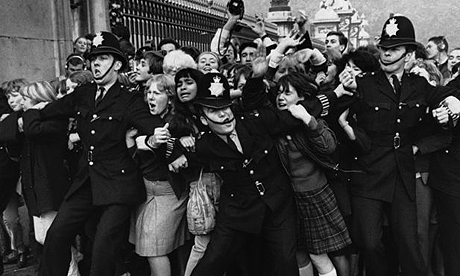 |
| Beatles fans in the 1960s. Uranus conjunct Pluto. Neptune in Scorpio. |
“Madness,” wrote Friedrich Nietzsche, “is the exception in individuals, but the rule in groups.”
That would explain why psychopaths rise to the top then. The rest of us mill around being all reasonable, when really the way to succeed in a group is to appeal directly to the irrational, to the emotional, to the instinctive. Just look at politicians, or brands.
But what is our collective madness right now? And is there any point in trying to grasp it rationally when we know this is a group feeling that each of us individually feels to a greater or lesser extent, which each of us floats into and out of. The spirit of these times is all around us, and it’s a feeling we all participate in, not a rational debate. And this zeitgeist, like a shapeshifting spirit, changes shape and form depending on the cultural context in which it finds itself. In Tahrir Square or at Wimbledon, in Shanghai or Red Square, the energy manifests differently. But it is never rational…
In astrology, we talk about the transpersonal planets – Uranus, Neptune, Pluto; the social planets – Jupiter and Saturn; and the personal planets – Sun, Moon, Mercury, Venus and Mars.
So it is the planets from Saturn through Pluto that rule our collective behaviour, influencing eras and generations. It’s the patterns between these outer planets that create the zeitgeist.
Right now, we have Uranus in Aries. There is no doubt that we can see the effect on the collective has been revolutionary. Uranus is the planet of revolution and change, the rebel. Aries is the sign of action and the individual. Aries is, in fact, the least collective sign of all. It’s the most personal. Aries, generally speaking, is the least aware of other people as full individuals. All experience for Aries has to be direct in order to be understood. So Uranus went into Aries in 2O1O and will leave in 2O18. By now you should have some inkling of how this is working for you.
With these heavy planets in this favourable sextile pattern, this is where change is happening. Pluto went into Capricorn in 2008; Neptune into Pisces in 2011. There’s still more than a decade to go with this energy.
Now, we have a doubly collective base underpinning this very personal group rebellion. Yes, that is an intentional oxymoron.
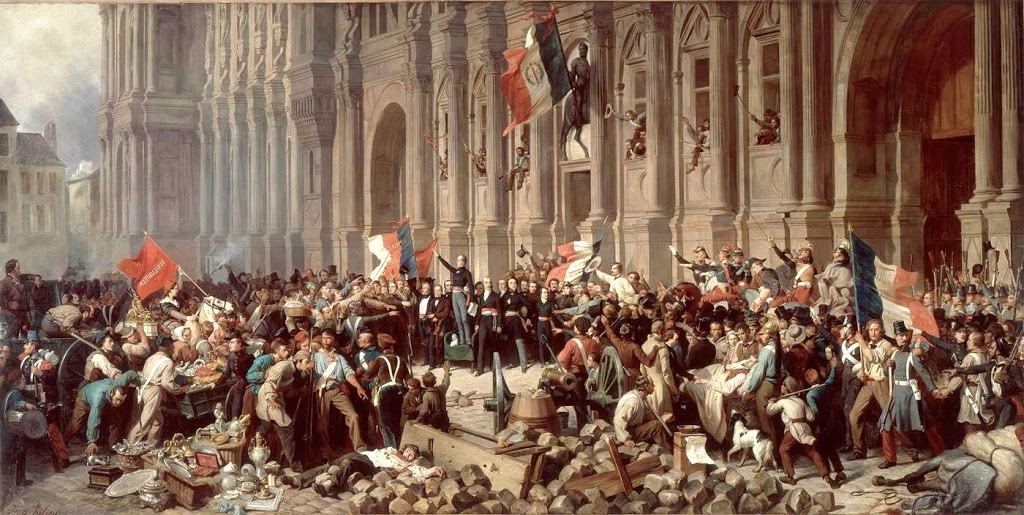 |
| Lamartine speaking to the people of Paris in 1848 by Felix Phillipoteaux. Uranus in Aries, Neptune in Pisces, Pluto in Aries |
Aries is also the sign of youth and inexperience, whereas Capricorn is the sign of old age and experience. They are at right-angles to each other spiritually as well as actually in the chart. Capricorn has been there, done that, got the scars to prove it; Aries needs to go and do it for himself. There is no teaching Aries, he learns through his own direct experience. We have had revolutions in the Middle East and the Occupy movement: clearly manifestations of Uranus in Aries. Now the heavy hand of Capricorn demands a price is paid.
Currently – and for around two more years – Saturn, Capricorn’s planet, is in Scorpio, Pluto’s sign, so they are in mutual reception. Capricorn and Saturn are about learning lessons. Saturn is the strict, disciplinarian teacher. Scorpio can be vengeful and relentless. Go figure. Capricorn is government. Bradley Manning and Edward Snowden are already paying the price for their Uranian rebellion. (Mannning in particular is very Uranian indeed with his tight natal Sun-Uranus-Saturn-Mercury conjunction.)
Revenge is in the air right now.
Pisces goes beyond even Capricorn, into the primordial chaos after the end and before the beginning. We have a square between youth and old age, between Pluto and Uranus, and in between we have Neptune, in his own sign, stirring up the soup of the collective, stirring up our emotions, our idealism, our imagination.
Occupy and the Arab Spring have been about imagining a better future. As I wrote a while ago now, they echo 1848, called the Year of Revolution, the Springtime of the People, which also took place as Neptune was in the last degrees of Aquarius, and moved into Pisces – and Uranus was in Aries. The revolutions disintegrated, old power institutions seemed to reassert themselves within a few years. In France, the crucible of that year, the Second Empire was declared in 1852, putting an end to the democracy that was established in 1848. It seemed as if everything would revert back to the way it had been – except in Denmark, where the reforms stayed.
That may sound negative, but the long-term ripples of that year of revolution spread the ideas of liberalism, socialism and universal suffrage. That year was the turning point in giving the people of Europe, and eventually the world, a stronger voice in government.
 |
| Bankers. |
The system of democracy as we know it now is not the terminus of history, it is not the endpoint. It can evolve into something better, something less corruptible, something which allows all the citizens of the world dignity and freedom. That is the narrative of Neptune in Pisces and Uranus in Aries: the end and the beginning.
It’s not easy: Pluto in Capricorn will resist this revolution until Uranus moves into Taurus in five years. Then constructive change can and must take place as the two earth signs work together. Pluto is the planet of transformation and regeneration: where Pluto transits, he demands total rebirth. Since Capricorn is the sign of government and large international corporations and institutions, this is where he is working. There is a battle on though, and the outcome is uncertain.
The gods are not always kind. Pluto could end by giving even more power to those institutions. For example, the vaunted reformation of international banking has yet to take place. In fact, the banks are now even more profitable; creepily rising like undead vampires. We need global institutions to re-imagine paradigms now. The very people who talk about “blue-sky thinking” and “thinking outside the box” need to stop thinking and start imagining and intuiting – maybe.
It’s not until 2O26 that Pluto and Uranus actually come into harmonious aspect – and by then they will be in air signs, the thinking signs. Neptune will be in Aries by then, envisioning a new beginning, and all three planets will be talking constructively.
But what about our current madness? How does this zeitgeist affect our individual sanity?
That is a question for your own chart.
Malcolm Gladwell’s book Blink: Thinking Without Thinking is essentially a defence of intuition, a good read for the fiery or watery of mind, or for those air signs who just don’t understand how other people are reach their conclusions.
.
Makes sense. I’ve been trying not to get too absorbed in Egypt’s heartbreaking meltdown — very much “my brother is my enemy” stuff. Meanwhile, the PTB in the US and UK are asserting their totalitarian attitudes at levels not seen in roughly a century, and even then, there wasn’t as much wholesale destruction of people and resources. I’m beginning to wonder if there’s really any hope for a survivable future, but if we can make it another 13 years, there might be. Which still leaves it as an open question…
The collective madness has been picking up pace through the late 20th century to where we are now. Now instead of looking after the people, the banks and large businesses are looked after by tax payers money. Meanwhile no one much complains because they are too scared, probably of losing what they do have. There is of course the totalitarian police state that you mention, quite rightly too. The complete transfer of power from the individual to government, government appointed bodies such as ombudsman this – ombudsman that – that really are a law unto themselves and dont help the individual get anywhere – an illusion if you will (is this neptune or saturn?) Mind you the banks being liquid is also an illusion – they are all zombies expecting an handout from the tax payer in one form or another. Meanwhile those on welfare, the victims of the madness, are scapegoated, as if they are the cause of the trouble as they are really in control of the economy, not the government as is really the case (a classic case of misdirection or saturn/neptune deception depending on your flavour of astrology). Meanwhile mindless television programmes and stupid reality tv and talent competions is all the media can redirect our attention away from what is really happening. GRRR!!
“Complete transfer of power from the individual to government”..? I can’t think of a time in history when individuals have EVER had any real power.
Anonymous, consider reading some history that isn’t in the usual textbooks — you’ll be very pleasantly surprised 🙂
In the Middle Ages in Europe, there were areas that were entirely communal. This usually happened when the remaining hereditary lord died and the people decided to just get on with things instead of bringing in an outsider. Occasionally, it happened because he was such a jerk that they rose up against him and gave up on feudality as a workable meme.
In the Andes, in part of what’s now Chile, there was a substantial society (for the time) which had absolutely no poverty. Trade between the sea and the arable hills made diets well-rounded. Everyone was housed. The social structure was technically heirarchical, but the gap between highest and lowest just wasn’t that large.
Throughout history, there have been pockets of these egalitarian societies on every continent, over and over. They are small and the people within them interconnected in fairly obvious ways. This is the key to sustainability. It’s harder to destroy people you know you’re connected to.
Massive societies have their own destruction woven into the fabric, one way or another, and it probably begins when the lowest are irrelevant to the highest; then the gap between them grows ever larger, the highest fail in their responsibilities, and so on.
Empire and dictatorship is innately corrupt. Worse still, their leaders have forgotten the key lesson of history: never let a quorum of people become so poor and so desperate that they have nothing to lose.
I think the anon2 may have a point, if its looked at in its deeper context. Even in the egalitarian societies there has to be some acquiescing of personal power. you cant have complete control like I dont like him I will kill him. But the idea in general that Isy writes is nice. Often I have wanted to escape society. There appears to be no where to run. Its just too big now. Maybe the powers that be will quickly have their big world war to get rid of 90% of the population. I was watching the second part of (part deux) of “do not watch this” on you tube. One of the things it mentions is that you get everyone into debt and the only way to clear the books is for there to be a war. This way you get rid of the debtors and the economy can regrow. Persoanlly I prefer steve keens idea that there should be a debt jubilee as some ancient societies had. Every fifty years the slate was cleaned. But this is just all hippy-psycho-babble. Blah blah blah.